
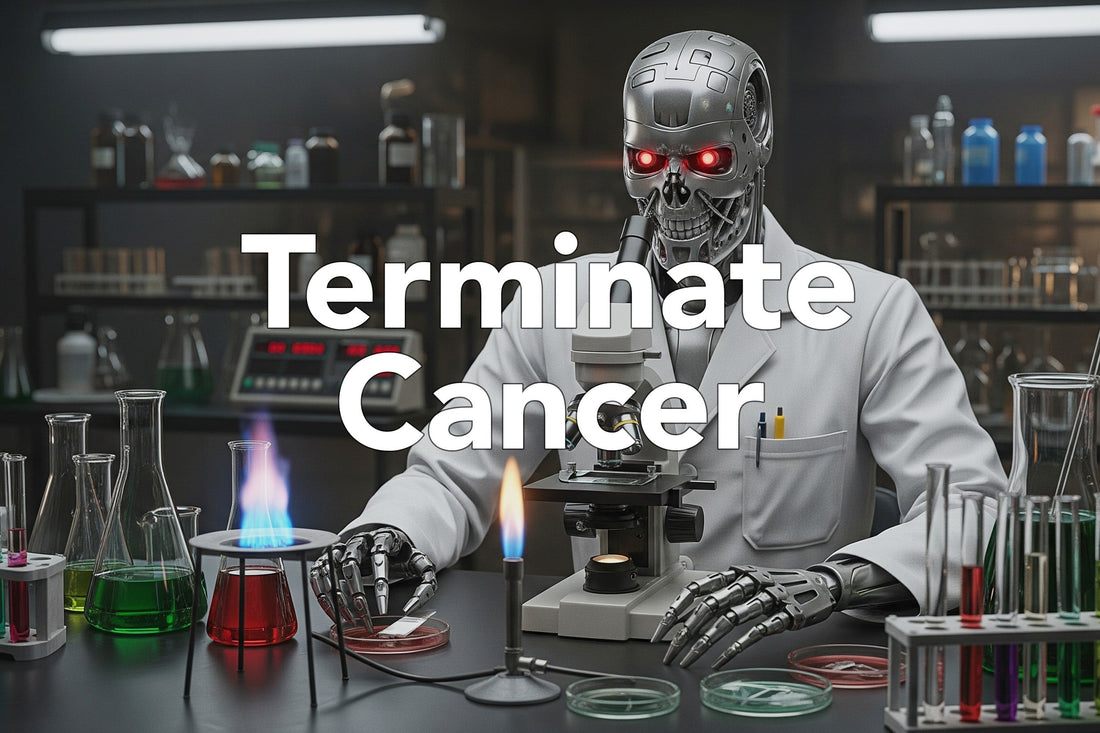
As much as it seems like artificial intelligence is going to take over the world, there may be -- actually, there IS -- a massive benefit to letting it do its thing.
Like, fighting cancer.
Scientists are constantly seeking new ways to combat cancer. But what if the next breakthrough isn't a new drug? What if it's a medication already used for something completely different, like diabetes or high cholesterol?
Well, now, thanks to the power of AI, researchers are discovering that common, non-cancer drugs can also kill cancer cells, opening up an exciting and unexpected new front in the war on cancer.
This innovative approach is called drug repurposing or drug repositioning. It's the process of finding new uses for existing, approved drugs. The traditional method of discovering new drugs is incredibly slow and expensive. It can take over a decade and billions of dollars to bring a single new drug to market. Drug repurposing offers a massive shortcut. Since these drugs have already been tested for safety in humans, they can move into clinical trials for their new purpose much faster and at a fraction of the cost.
So, how does AI find these hidden gems? The answer lies in its ability to analyze colossal amounts of data at a speed no human ever could. A recent study, led by University of Cambridge researchers in partnership with King's College London and Arctoris Ltd, tested this idea. The research focused on GPT-4, a large language model (LLM) that is trained on vast amounts of internet text. The team designed prompts that asked GPT-4 to generate pairs of drugs that could work against MCF7 breast cancer cells without harming healthy cells (MCF10A).
They also limited the model from using established cancer medications and directed it to focus on options that are cost-effective and have already received approval for use in humans.
The results were fascinating. Several well-known drugs are being studied for their anti-cancer properties. These included medications for conditions like high cholesterol, parasitic infections, and alcohol dependence. In its first round, GPT-4 proposed 12 unique drug combinations. GPT-4 even provided explanations for each pairing, often tying together biological pathways in unexpected ways.
The next step involved testing drug combinations in the lab. Scientists measured the effectiveness of the combination against MCF7 cancer cells and the damage to MCF10A healthy cells, looking for whether the drugs worked better together than separately.
Three combinations showed better results than standard cancer therapies: simvastatin (typically used to lower cholesterol) with disulfiram (used to treat alcoholism), dipyridamole (for blood clots) with mebendazole (for parasitic infections), and itraconazole (antifungal) with atenolol (for high blood pressure). These pairs were effective against MCF7 cells while causing minimal harm to healthy cells.
After the initial results, researchers asked GPT-4 to analyze what worked and propose new ideas. They provided summaries of the lab findings and asked the AI to propose four additional drug combinations, including some that included known cancer drugs, such as fulvestrant.
The AI suggested combinations like disulfiram with quinacrine and mebendazole with quinacrine, with three of four showing promising synergy scores. The most effective was disulfiram with simvastatin, achieving the highest synergy score of over 10 on the HSA scale.
The feedback loop consists of AI suggesting ideas, humans testing them, and then feeding results back to the AI. This cyclical process allows both machines and humans to improve as they continuously learn through each iteration.
Among the twelve original combinations, six, which included unusual pairings, showed positive synergy scores.
Eight of the twelve combinations showed greater effects on MCF7 cells than on MCF10A cells, indicating good specificity. The most toxic drugs for MCF7 included disulfiram, quinacrine, niclosamide, and dipyridamole, with disulfiram having the lowest IC50 value. Researchers were surprised by GPT-4's ability to effectively pair non-cancer drugs.
But, nothing is perfect. GPT-4 can sometimes make errors known as "hallucinations." These hallucinations are statements that are not supported by its training data. While hallucinations are often considered flaws, they can still be useful in generating unique hypotheses.
In this study, one such hallucination claimed itraconazole impairs cell membrane integrity in human cells. While this is accurate for fungi, human cells don't follow the same pathway. That mistake, however, still led to successful experiments.
The research team believes AI and lab automation could eventually lower the cost of personalized medicine. Future cancer treatments may involve customized projects for each patient, allowing therapies to be tested and tailored in real-time. While lab costs are currently high, AI tools like GPT-4 help generate functional hypotheses quickly, and advancements in robotics could further reduce testing expenses.
"Our empirical results demonstrate that the GPT-4 succeeded in its primary task of forming novel and useful hypotheses," the authors concluded.
This study highlights that AI, such as GPT-4, can generate new scientific knowledge rather than just summarize or analyze data. It proposes innovative ideas, learns from results, and provides improved suggestions, indicating the potential for repurposing existing drugs for new uses. While clinical trials are still necessary, this approach could significantly reduce development time.
Here's hoping the future is too far off.
Sources:
https://pmc.ncbi.nlm.nih.gov/articles/PMC9945820/
https://royalsocietypublishing.org/doi/10.1098/rsif.2024.0674
https://www.geeksforgeeks.org/artificial-intelligence/large-languagedidn/
https://en.wikipedia.org/wiki/MCF-7
https://pmc.ncbi.nlm.nih.gov/articles/PMC4493126/
https://www.sciencedirect.com/science/article/pii/S1672022922000080
